
What Does Asbestos Cement Look Like? A Visual Guide With Photos
Here’s the uncomfortable truth about spotting asbestos cement by eye: in most cases, you genuinely can’t. Asbestos-containing material and asbestos-free material can look identical, sit side by side on the same wall, and fool people who’ve been in the trade for decades. That’s not us being difficult about it. It’s the honest starting point for this guide.
What visual identification can do is narrow things down. Certain products, certain textures and certain eras raise the odds enough that testing becomes the obvious next step rather than an overreaction. That’s what this guide is for.
Request A free Quote Today!
Why Visual Identification Only Gets You So Far
Asbestos cement is asbestos fibres bound into cement, and once that mixture is set and painted, there's nothing about its surface that reliably announces what's inside. A flat grey sheet from 1975 can look exactly like a flat grey sheet from 2015. Mould, weathering and old paint make things murkier still, since a mottled or patchy surface can show up on both asbestos and non-asbestos material for completely unrelated reasons. This is why we lead with product type and era rather than colour or texture alone. Knowing what you're looking at, and roughly when it went up, beats staring hard at the surface every time. Picture two identical grey sheets fixed to a garage wall, one installed in 1974 and one installed last year as a repair. Same colour, same profile, same weathering from the same Auckland weather. There is no photo comparison that reliably tells those two sheets apart, and that's true across almost every product in this guide. What follows is a way to narrow the odds, not a way to skip the lab.
Corrugated Roofing
Super Six is the roofing product most Aucklanders picture when they think "asbestos roof." We've covered identifying Super Six in detail separately, but the short version is a corrugated grey sheet with wider, deeper ridges than modern steel, noticeably heavier to lift, and fixed with hook bolts or screws through a lead or bituminous washer rather than tidy self-drilling screws. Age is the biggest clue here. If the roof predates the early 1980s and hasn't been replaced, corrugated cement roofing is a genuine possibility regardless of what colour it's currently painted. A lot of these roofs have been repainted several times over the decades, sometimes with different colours layered on top of each other, which changes the surface entirely without changing what's underneath it.
Flat Sheet Cladding, Soffits And Eaves
This is the trickiest category, because flat fibre-cement sheet is still manufactured today, asbestos-free, and it can look almost identical to the original product. Older sheet, sold under names like Fibrolite and several others we've covered in our brand identification guide, tends to be denser and heavier than modern equivalents, with a rougher, less uniform cut edge. You'll typically find it on eaves, soffits, gable ends and wet-area wall linings in homes from the 1950s through the 1970s. Some products, like Tilux, have a distinct patterned surface with visible silver metal cover strips at the joins, which is a genuinely useful visual tell when you know to look for it. Soffits are worth a closer look than most people give them. They sit under the eaves, out of direct weather, which often means the original sheet has survived untouched for fifty-odd years while the rest of the house has been re-clad, repainted and renovated around it. A tidy, freshly painted house can still have original 1960s sheet running the length of every eave.
Textured Ceilings And Walls
Textured coatings are one of the more recognisable categories, at least in terms of pattern. Think stippled, swirled or the classic "popcorn" finish, sprayed or trowelled onto ceilings and sometimes walls, mostly through the 1970s into the early 1980s. The pattern itself doesn't confirm asbestos content, since plenty of texture coatings from any era share a similar look, but a heavily textured ceiling in an untouched 1970s room is worth flagging. Bathrooms and laundries tend to hold onto original texture longer than living areas, simply because they get renovated less often, so check those rooms even if the lounge ceiling has clearly been redone.
Vinyl Floor Tiles
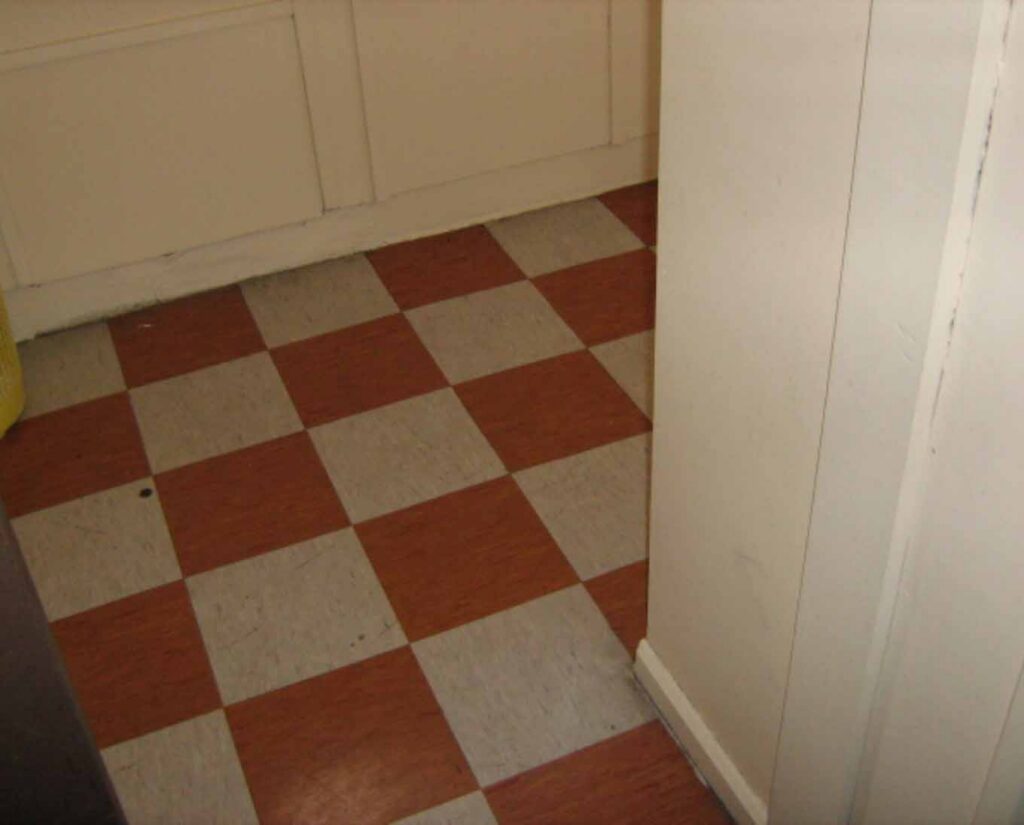
Older vinyl tiles were commonly produced in set sizes, often 9 by 9 inches, sometimes 12 by 12 or 6 by 6, a leftover from the imperial measurements used before New Zealand went metric. Colours ran from muted browns and greys through to brighter mid-century tones, and you'll often find them hiding under a later layer of flooring rather than on open display, since ripping up old tiles wasn't always standard practice during a renovation. Kitchens and laundries are the most common spot, tucked under carpet, vinyl sheet or even a newer layer of tiles laid straight on top rather than removed.
Pipe Lagging And Old Plumbing
 Underground and under-house pipework is easy to forget about entirely. Older asbestos-cement pipe often has a whitish-grey colour, and lagging wrapped around pipes and fittings, particularly near hot water cylinders and boilers, can look like a plaster-like coating in white, grey or a faint blue-grey tone. If you're doing any work under the house or around an older hot water system and come across wrapped or coated pipework you don't recognise, that's a stop-and-check situation rather than something to work around.
Around The Section: Fences, Sheds And Garden Beds
Asbestos cement wasn't confined to the house itself. Its durability made it a popular choice for fences, garden sheds, carports and even garden bed edging, anywhere a cheap, weatherproof, fire-resistant sheet made practical sense outdoors. A flat grey fence panel or an old shed wall on a property from this era deserves the same scrutiny as the house cladding, arguably more, since outdoor material tends to weather harder and gets knocked, drilled and cut into far more casually than anything inside the home.
When A Photo Isn't Enough
Every category above narrows the odds. None of them settles the question, which is exactly why "what does asbestos look like" is the wrong question to stake a decision on. Have a browse through our project gallery for a sense of what these materials look like in real Auckland homes, then get the specific material in your own property properly checked. Asbestos testing takes a small sample from the material in question and sends it to an accredited lab, with results back within a few working days. If it comes back positive on a roof, our asbestos roof removal team can take it from there under full containment.
Common Questions About Identifying Asbestos
Can I tell if something has asbestos just by looking at it?
Not reliably. Visual clues like age, product type and texture can raise or lower the odds, but asbestos and non-asbestos materials can look identical once painted, weathered or covered. Testing is the only way to know for certain.
What's the most reliable visual clue?
Age and product type together, rather than any single physical feature. A corrugated cement roof from the 1960s, a textured ceiling from an untouched 1970s room, or flat sheet cladding on a house that's never been re-clad are all reasonable candidates worth testing.
Is it safe to scrape or break a sample myself to check?
No. Disturbing suspect material is exactly how fibres become airborne, and a visual check afterwards still won't tell you anything a lab result wouldn't tell you more safely. Leave sampling to people equipped to do it properly.